ExplainedFood
Korean BBQ in Gangnam: How It Works, From the Table Grill to the Last Bowl of Noodles
How Korean BBQ in Gangnam works: the table grill, who cooks, pork belly and marinated beef, banchan refills, ssam wraps, sauces and how the meal ends.
5 min read
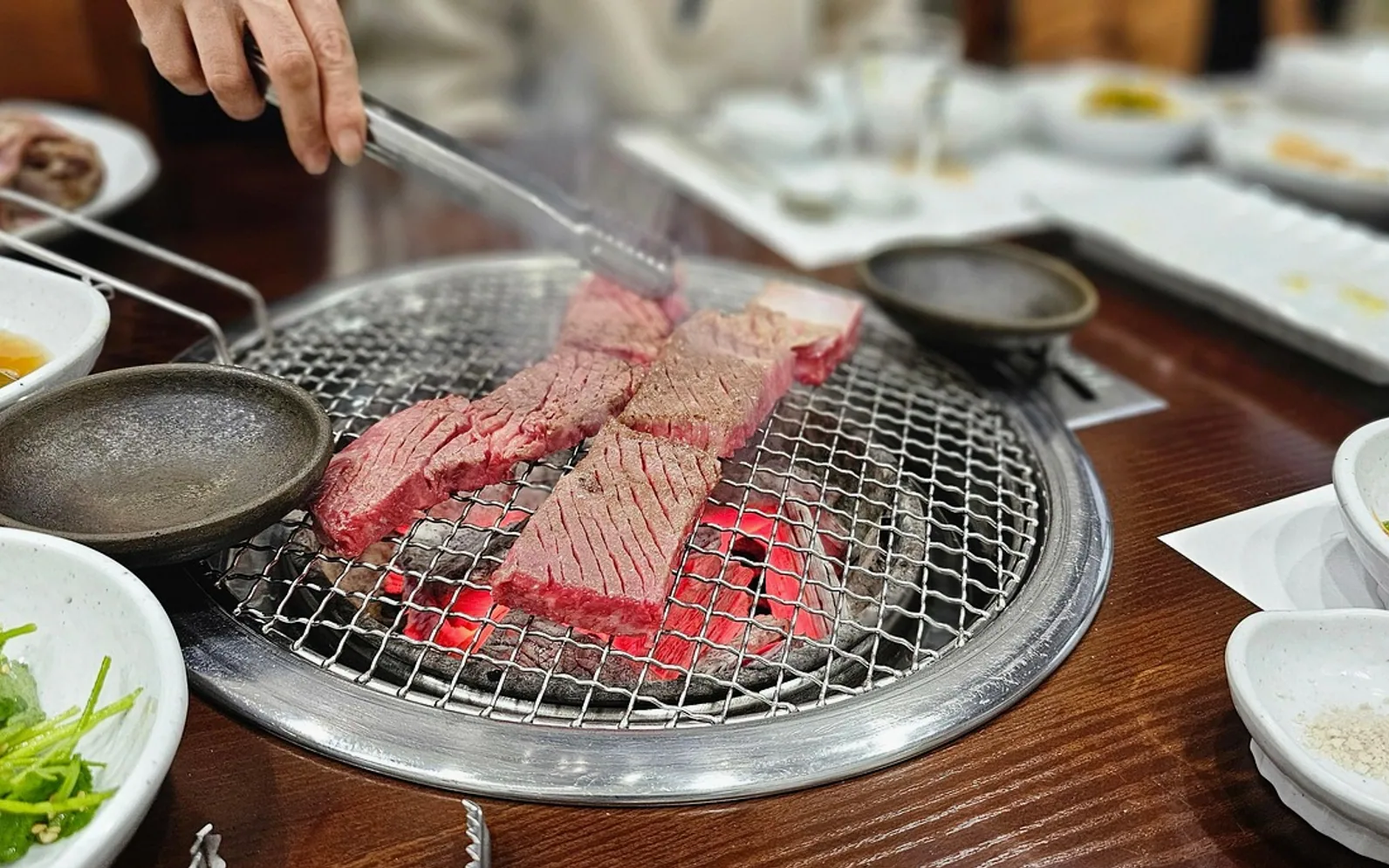
Korean BBQ in Gangnam works like this: you sit at a table with a grill built into its centre, order raw meat by the portion, cook it there in front of you (or watch a staff member do it), and eat it with a spread of small side dishes, fresh lettuce leaves and dipping sauces. Once the meat is gone, most groups order a closing dish such as fried rice, cold noodles or a bubbling stew. The format is relaxed and social, and after one visit the routine feels obvious.
The table and the grill
The grill is the centrepiece. Depending on the restaurant it may run on charcoal, gas or electricity, and it usually sits under an extractor hood that hangs from the ceiling and pulls smoke away. Some places use a flat iron plate, others a grate over glowing coals.
The smell of grilled meat clings to clothes, so use the bag or lidded bench seat that many restaurants provide for coats.
Who does the grilling?
This varies more than first-time visitors expect. In some restaurants a staff member comes to the table, lays the meat on the grill, flips it and cuts it with kitchen scissors into bite-sized pieces. In others the tongs and scissors are simply placed beside you and the table is trusted to manage. If nobody appears after the meat arrives, it usually means you are expected to cook yourselves.
A few practical habits help when you take over:
- Let the grill heat properly before the first strips go on, so the meat sears instead of steaming.
- Turn pork belly only once or twice so it can crisp.
- Use the scissors once the outside is browned, then finish the smaller pieces.
- Pork needs to be cooked through; thin beef cuts are ready after a very short time.
- Ask for the grill plate to be changed when it turns black and sticky. Staff do this routinely.
The cuts you will see on the menu
Menus differ, but a handful of cuts appear almost everywhere. Ordering usually works per portion, and many restaurants ask for a minimum of two portions for the first round.
| Cut | What it is | How it is usually eaten |
|---|---|---|
| Samgyeopsal | Unmarinated pork belly in thick or thin slices | Grilled until crisp, dipped in sesame oil with salt, or wrapped in lettuce |
| Moksal | Pork neck or shoulder, leaner than belly | Grilled in thick pieces and cut at the table |
| Bulgogi | Thin beef slices in a sweet soy marinade | Cooked quickly, often on a plate rather than a grate |
| Galbi | Beef or pork short rib, usually marinated | Grilled on the bone, then cut free with scissors |
| Chadolbaegi | Very thin slices of beef brisket | Seconds on the grill, then straight into a sauce |
Unmarinated cuts are normally grilled first and marinated ones later, because the sugar in the marinade burns onto the plate.
Banchan and refills
Before the meat arrives, the table fills up with banchan: small side dishes such as kimchi, pickled radish, seasoned bean sprouts, spring onion salad, steamed egg or a thin soup. These come with the meal rather than being ordered separately, and in most restaurants they are refilled on request. Some places have a self-service counter where you top up the dishes yourself; elsewhere you simply raise a hand and ask.
The sharper dishes, such as kimchi, are there to cut through the richness of the meat.
How to build a ssam wrap
Ssam means a wrap, and it is the most common way to eat grilled meat at the table. There is no strict recipe, but the usual order is:
- Take a lettuce or perilla leaf in an open palm.
- Add a piece of meat, dipped in sauce if you like.
- Top it with a little ssamjang (a thick, savoury bean and chilli paste), a slice of raw or grilled garlic, and perhaps some spring onion salad or kimchi.
- Fold it into a small parcel and eat it in one bite.
The dipping sauces
Most tables get two or three dipping options. Sesame oil with salt and pepper suits plain pork; ssamjang works inside wraps; and a soy-based sauce, sometimes with onion or chilli, pairs well with brisket. The same principle applies throughout: unmarinated meat takes stronger dips, marinated meat needs little or none.
How the meal ends
Korean BBQ rarely stops at the meat. Near the end, groups often order a final dish to round things off. Common choices include bokkeumbap (rice fried directly on the grill with leftover meat, kimchi and seaweed), naengmyeon (cold buckwheat noodles in an icy broth or with a spicy sauce, popular in warmer months), and doenjang jjigae, a soybean paste stew served with a bowl of rice.
Table etiquette worth knowing
- Wait for the eldest person at the table to start eating, especially in a family or work group.
- When pouring drinks, pour for others rather than yourself, and hold the bottle or glass with two hands for older guests.
- Do not stand chopsticks upright in a bowl of rice.
- Sharing is the default: everything on the grill belongs to the whole table.
- Soju and beer are common with grilled meat; know your limits, drink water alongside, and never drive afterwards.
For readers interested in how food reaches restaurant kitchens in the first place, our piece on working with food distributors looks at the supply side of the same story.
What comes after dinner
A BBQ dinner in Gangnam often turns into a longer evening. Some groups head to a dessert café for bingsu (shaved ice) or coffee; others walk off the meal along the quieter side streets or towards one of the nearby parks. Singing is another familiar next step: a noraebang, a private karaoke room booked by the hour, gives a group its own space, a song catalogue and a pair of microphones. For an overview of how those rooms work in the district, the guide at Karaoke of Gangnam covers the practical side of a visit.
The area is well served by the subway and buses; for how transit shapes city life, see our article on public transport upgrades and city neighbourhoods.
Do I need to tip?
Tipping is not a common custom in Korean restaurants. You usually pay at the counter near the exit when you leave, rather than at the table.
Once you know the pattern of grill, side dishes, wraps and a closing dish, Korean BBQ becomes one of the easiest meals to share, whether it is a first night in Seoul or a regular get-together.
Across the sections
Editor’s picks
 TechnologyAI Headshot Generators: The Fast Track to Professional-Looking Photos3 min
 BusinessEnhancing RAG Systems Through User Feedback2 min
 TechnologyWhat Is a Streaming Stick? A Plain Look at the Plug-In TV Gadget4 min
 BusinessFrom Nigeria to the World: Exploring Citizenship by Investment Programs Abroad3 min
Spotted a mistake?
Suggestions help us plan.